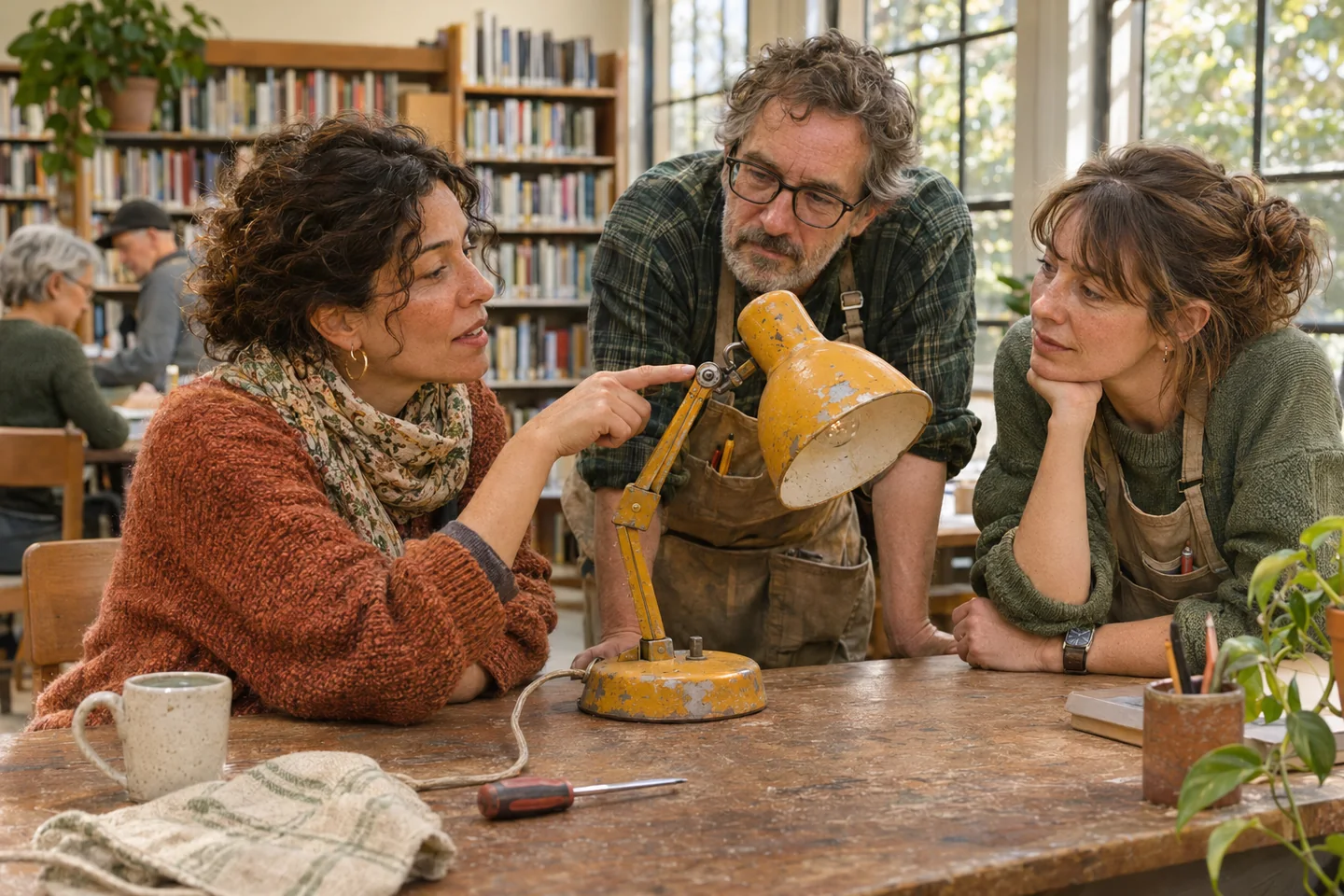
Imagine making a poster for a repair night at your local library. You ask an image generator for ideas, and a screen fills with handsome versions of the same event. A workbench glows under a pendant lamp. The tools hang in neat rows. There’s even an old radio with the sort of dial you want to reach out and turn. You could spend the rest of the evening deciding which picture looks best.
Then you talk to one of the volunteers. Last time, someone carried a broken lamp across town and stood in the library lobby for ten minutes, unsure whether they needed an appointment. The volunteer has one request for the poster this time. Put “Walk in with one broken item” where people can read it from the sidewalk.
The good pictures are still good pictures. The conversation has given you a better idea of what your poster is for. As images, videos and layouts get easier to produce, that distinction becomes more consequential. If a beautiful image is only a few requests away, what makes one worth remembering? Sometimes the answer is a detail you would have missed if your first version had looked finished enough to print.
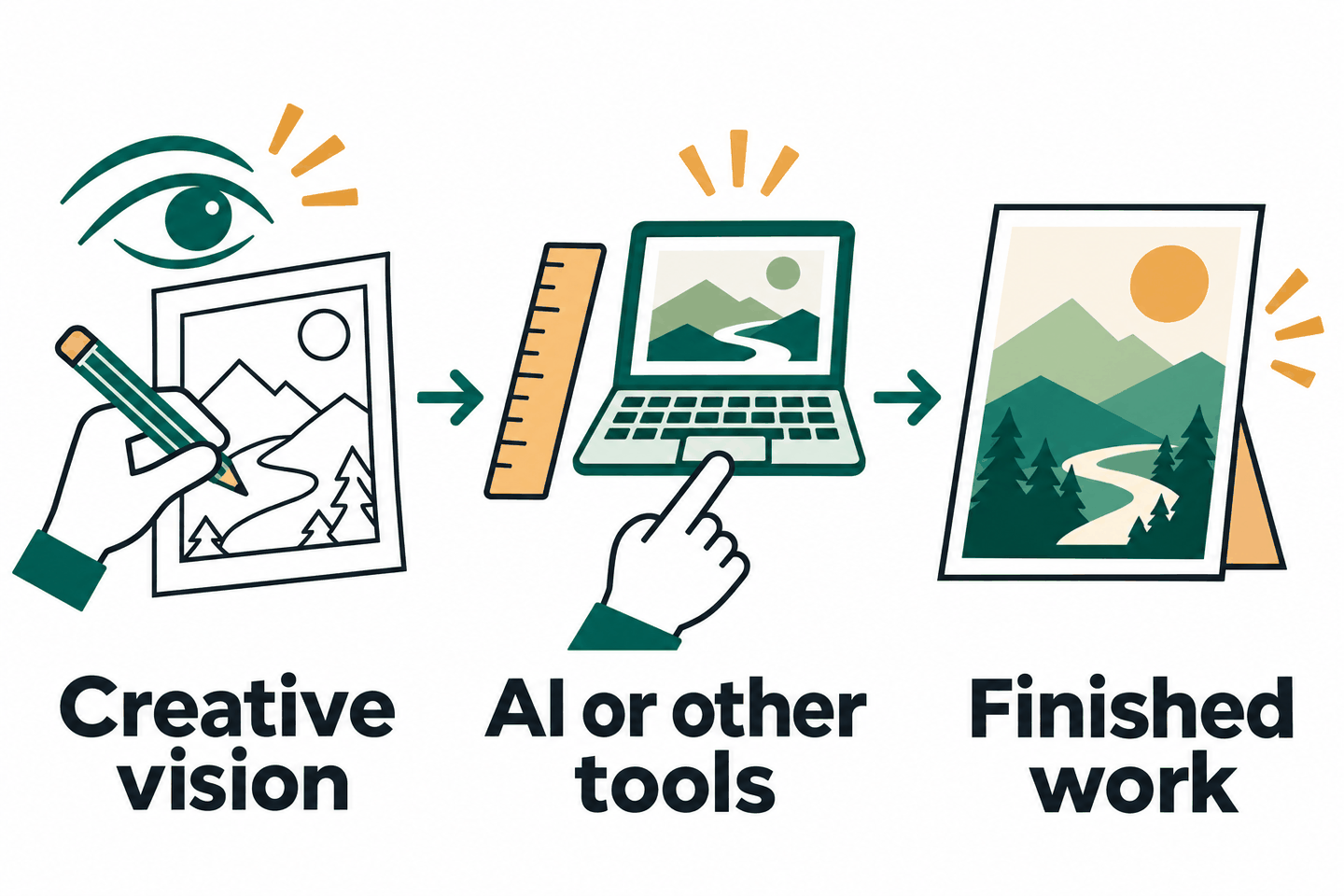
The idea and the making
Creating something takes both an idea and the work of building it. An idea can start when you notice something worth sharing. Making gives it a form other people can see, hear or use. Think of a short film set at the bus shelter where you spent your teenage years. You can picture it long before you know how to shoot it in the rain, edit the footage and make the dialogue audible.
Making takes time and money, and it often calls for skills people have had little chance to acquire. Consider someone who can tell a wonderful story aloud and has never learned to edit audio. If AI turns a recorded conversation into a searchable transcript, they have a way to find the passages they want to work with. A rough prototype can also give a small team something concrete to show a potential collaborator. When AI makes these early steps easier, more people can try ideas they might otherwise leave unmade.
The distinction gets more interesting once you start making something. A photographer walks around a subject and notices that the picture improves when the subject moves farther from the window. A tailor pins a seam and discovers that the interesting part of the garment is what happens when somebody sits down. Even a sheet of paper can offer useful resistance. Tape the library poster to a window, walk across the street and see which words survive the reflection. The experience can change what you think deserves the biggest type.
This is why handing over all the making can cost some of the thinking. The parts worth keeping depend on the work. A documentary maker can happily automate the first pass at a transcript and still spend an afternoon listening to the pause before an answer. The pause may contain the story they came for.
Inspect F1 at full size
This view keeps the selected image at its original dimensions. Focus the frame and use arrow keys to scroll.
What happens to the time we save?
In a 2023 experiment, Shakked Noy and Whitney Zhang assigned work-related writing tasks to 453 college-educated professionals. Participants given access to ChatGPT took 40 percent less time on average, and their work received higher quality ratings. The experiment in Science
Getting through a task faster frees up time. Putting it toward original thinking takes a choice. A freelance producer could use part of an afternoon to call a second interviewee and discover that the story they planned to tell was too simple. They could go back through their notes, spend more time where the story takes place or sketch a new idea before asking a tool for suggestions. That same afternoon could go toward producing six versions of the original story for six channels. There are weeks when that choice pays the bills. When it becomes the default, saving time simply changes how much work is expected by Friday.
There’s an individual version of that pressure, too. A draft that already sounds competent makes it easy to keep adjusting the sentences while leaving the original premise in place. A colleague asking why the least interesting point gets the first paragraph can do more for the draft than another quick round of edits.
AI can make that reconsideration easier. Give it an idea you’ve formed and ask for a plausible objection, a different audience or a question the piece leaves unanswered. Getting an answer is only the beginning of that exchange. Its value depends on what you decide to investigate, rethink or let stand.
When polish is easy to find
Anil Doshi and Oliver Hauser ran a 2024 experiment in which people wrote eight-sentence stories, with some writers able to request starting ideas from GPT-4. Readers rated stories from the groups with AI access more favorably on measures of creativity, especially for writers who scored lower on the study’s initial creativity measure. An analysis of the stories also found greater similarity within those groups. The same assistance could help an individual write a better-rated story and make the collection as a whole more similar. The short-story study in Science Advances
Eight-sentence fiction is a particular kind of assignment. The experiment leaves room for different results when people bring their own starting material, work in another medium or use an AI tool later in the process. It does, however, make it easier to imagine how good choices for individual creators might add up to something less interesting for the people reading or watching.
Creators have borrowed the look of successful work for as long as there has been work to borrow from. Conventions often help. It’s a relief to recognize a recipe page or find a familiar symbol on an unfamiliar train map. For a project that calls for a distinct point of view, the more demanding question is what you can bring that the brief leaves out. A photographer notices which part of the street stays busy in the rain. A designer asks who has trouble reading the sign everyone else thinks is clear. Each has a reason to change the work that goes beyond wanting it to look different.
What a picture can honestly say
Realism is about how convincingly something looks like the world. Authenticity asks what relationship the work has to the experience it presents. A synthetic drawing can give honest form to a remembered room. A photograph of a real meeting can leave out the people who objected. Both cases depend on what viewers are led to understand about the picture.
In experiments led by Lucas Bellaiche, researchers randomly labeled AI-generated paintings as human-created or AI-created. Viewers gave higher marks to paintings with the human label on measures such as liking and beauty. A claim about authorship was enough to change how people judged the image. The painting-label experiments
For the person making the picture, experience can shape the work long before anyone sees it. Suppose you’re drawing the kitchen where your grandmother used to make breakfast. In the picture, a spoon is wedged under a short table leg. An illustrator could invent the spoon. Its significance in your version comes from remembering how everyone heard the spoon scrape when someone leaned on the table. That detail might determine where you put the person in the scene, or what you leave quiet in the rest of the picture. The experience has changed the decisions.
You could draw that kitchen by hand, build it from old photographs or ask a generator for a rough study of the early light. If you present a reconstructed scene as an illustration of a memory, you give viewers the information they need to understand it. A caption claiming it was a photograph taken that morning would ask them to believe something else. Tools can help a person tell a true story. The person telling it still has to decide what they can honestly claim.
Choose the tool after you name the job
Some jobs come with an answer you can check. You have twelve photos, each needs to be 1,200 pixels wide, and the proportions must stay the same. A conventional batch resizer gives you a size setting and a result you can measure. If the job is to convert a folder of images to another format, you can compare the actual output with what the destination accepts. These are good places to favor a tool that performs the specified operation and makes the result easy to inspect.
Other jobs are open enough to benefit from suggestions. Say you have the idea for a poster and want to see how it might feel in three different moods. AI can give you sketches to react to. Before you look at them, jot down what the poster has to do, who will see it and which part of the message you refuse to lose. Afterward, ask someone from that audience to read it in the setting where it will appear. The rough versions are useful precisely because you have a way to judge them.
For creative work that makes a claim about a real person or event, keep the source material close. In a short video about a family shop, AI might help you find every mention of a particular year in the interview transcript. Listen back to the original before putting a line in the film. Check whether you have a picture of the event under discussion or an image that merely resembles it. The audience will infer a connection when you put a voice and a picture together. Deciding what that connection means is part of the edit.
Consider what you’ll need to change after you’ve made something. If the library changes the starting time, a poster with editable text takes a moment to update. If the time is embedded in a generated image, a correction can send you back through several versions and leave you checking whether other details changed. You can keep an illustration you like and set the words in a layout you control. For work you expect to reuse, the ability to revise one part without disturbing the rest can matter as much as how quickly you got to the first version.
The same project can call for different tools at different stages. A designer can use AI to explore a layout, adjust the type by hand and export the final artwork in a few standard sizes. A photographer can use software to process a batch and still decide which frame belongs in the series. You can also keep a laborious step simply because it’s the part you enjoy or the way you learn. A tool earns its place when it gives you something useful for the work at hand, including time and room to make a better choice.
More people should get to make things
Making a first film, a small game or an illustrated book can change what feels possible for someone used to being a reader, a customer or a spectator. Their first attempt may borrow familiar forms. Most beginners do. A second attempt gives them a chance to notice what the form gets wrong about their particular subject.
That’s a reason to cultivate habits that have little to do with mastering any single piece of software. Go back to a place after the light changes. Listen to how someone describes the job they do every day. Try an idea in a form you can show another person, and pay attention to where they stop reading. Keep the small pleasures of making in view as you decide what to delegate.
At the library, a generated illustration or a photo of the well-used workbench could serve the invitation. Either way, the person carrying a broken lamp needs to know from the sidewalk that they’re welcome to walk in. Used well, AI can give more people the time and confidence to notice a detail like that and decide what to do with it.
Editorial note. AI assisted with research, source checking, drafting and editing. Both illustrations were generated with AI for this article.